The Pop Art Lesson – Consumption, Identity, and Social Reality
28 Jan 2026

January 28 is Pop Art Day.
Pop Art is one of those artistic movements that fundamentally changed the way art came to be understood. Not through elitist refinement or hard-to-decode abstractions, but through images we recognize instantly: advertisements, comic strips, celebrities, supermarket products. Pop Art had the courage to show that everyday life, with all its commercial and repetitive aspects, is a legitimate subject for art.
Pop Art is not merely an artistic movement, but a true visual revolution, one that communicates through the language of advertising, comics, mass-produced goods, and pop icons. Today, on Pop Art Day, we celebrate the art that unapologetically declared: yes, mass culture matters.
The term Pop Art comes from “popular art” and defines a movement that emerged in the mid-20th century, drawing imagery and symbols from mass culture. Pop artists employ strong colors and contrasts, clear outlines, and techniques inspired by print and advertising, often reproducing the same image multiple times. Beneath its playful surface, Pop Art contains a serious dose of irony and social critique, addressing consumption, fame, identity, and the ways images shape our perception of reality.
The movement appeared almost simultaneously in the 1950s and 1960s in Great Britain and the United States. In Europe, artists viewed the explosion of American consumer culture with fascination, while in the U.S., Pop Art became a direct mirror of postwar society, shaped by advertising, television, and mass production. In many respects, it emerged as a reaction to abstract expressionism, which was seen as overly introspective and detached from everyday life.
The defining characteristics of Pop Art include bold, flat colors often inspired by print media, recognizable and easily “readable” images, the use of industrial techniques such as screen printing and mechanical reproduction, as well as irony, social critique, ambiguity, and the blurring of boundaries between art and consumption.
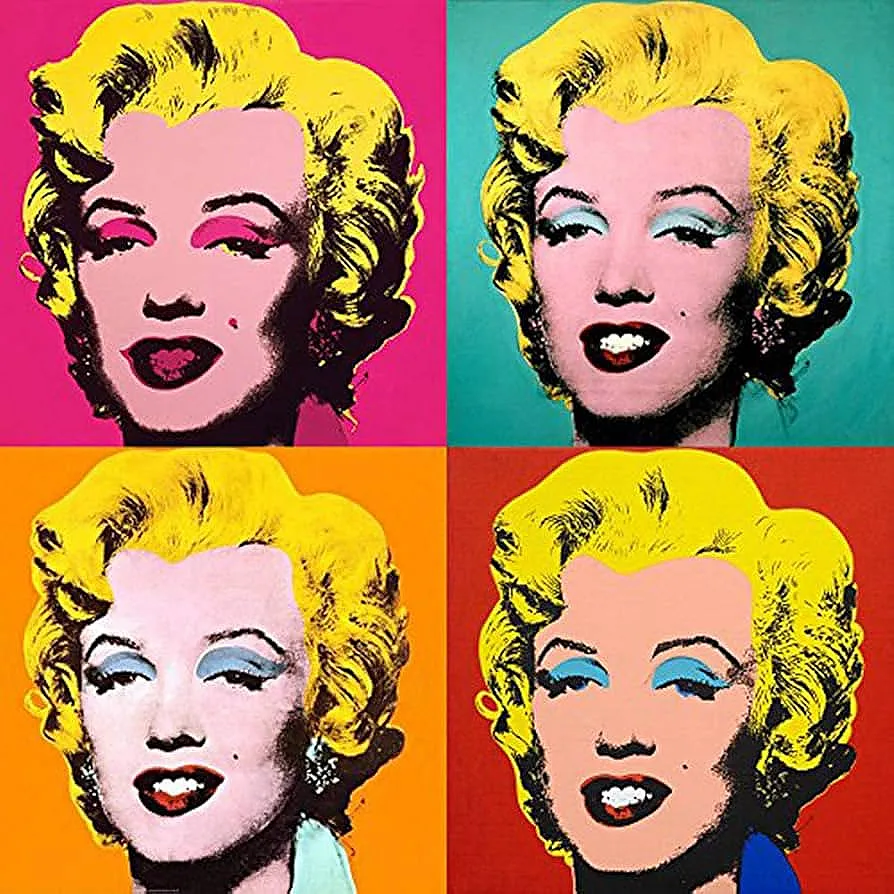
The most widely known name associated with Pop Art is, of course, Andy Warhol, the artist who transformed ordinary objects and famous faces into true visual icons. Campbell’s soup cans and portraits of Marilyn Monroe or Elvis Presley are not merely decorative images, but commentaries on mass production, fame, and ephemerality. Roy Lichtenstein, another emblematic figure, elevated comic strips to monumental scale, using typographic dots and dramatic frames to explore emotion as a visual product.
Richard Hamilton, one of the British pioneers of the movement, analyzed consumer society with clarity and wit, while Claes Oldenburg transformed everyday objects into oversized, soft or rigid sculptures that completely altered our relationship with familiar things. James Rosenquist, a former billboard painter, combined commercial and political imagery in monumental collages charged with visual tension.
If one were to choose a single artwork to represent the essence of Pop Art, it would be Andy Warhol’s Campbell’s Soup Cans, created in 1962. The series, composed of nearly identical images of a soup can, raises essential questions about originality, artistic value, and the role of the author. Simple at first glance yet profoundly powerful, it has become the ultimate symbol of the relationship between art and consumption.
Today, Pop Art is more relevant than ever. We live in a world dominated by images, brands, and visual repetition—precisely the themes this movement brought into question decades ago. Pop Art does not ask us to reject popular culture, but to view it critically, consciously, and creatively. On Pop Art Day, we celebrate the art that had the courage to be accessible, provocative, and deeply connected to the reality of its time.
by Cosmina Marcela Oltean
[Artwork - ''Marilyn Monroe'' by Andy Warhol]