The Representation of Women in Prehistory
07 Mar 2026
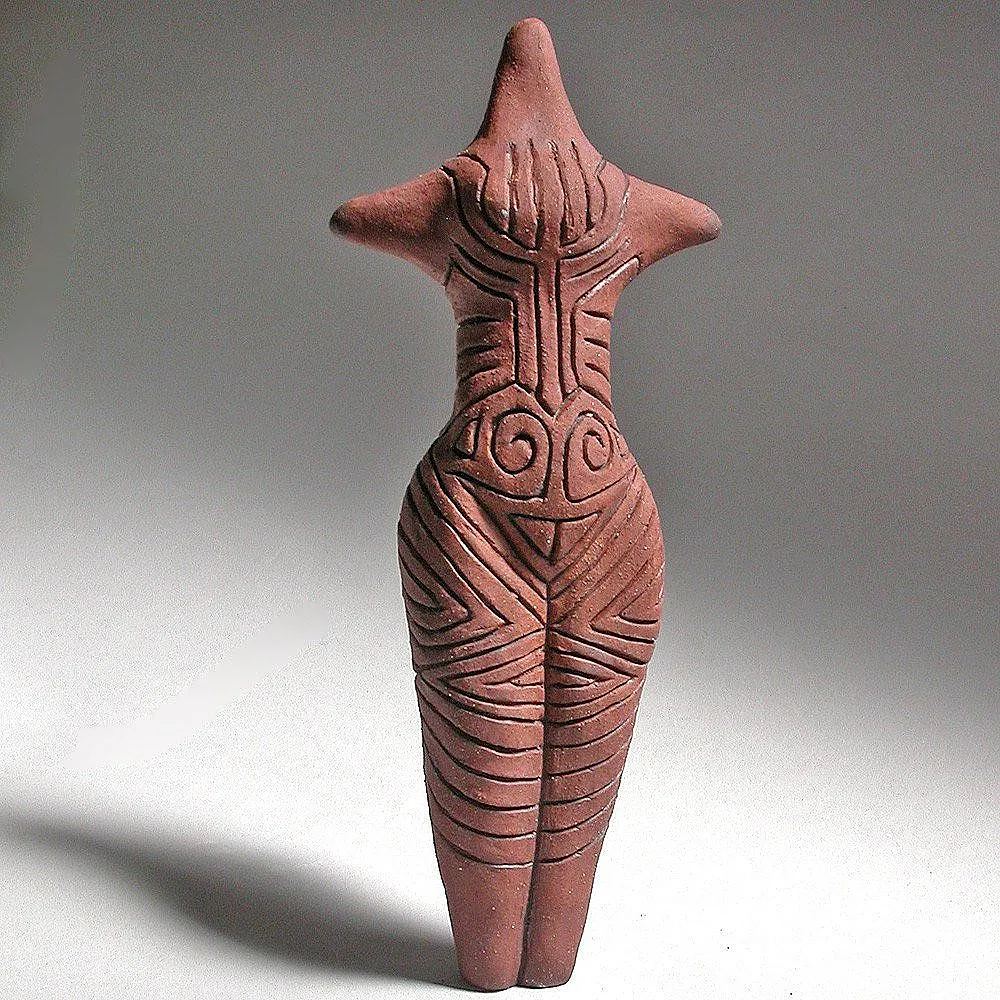

On the occasion of International Women’s Day, we take a brief journey into early art to explore how women were represented in prehistory and what these representations may have meant. Female anthropomorphic figurines are among the most widespread artefacts of the Neolithic period (ca. 7000–3000 BC), discovered in archaeological sites across Anatolia, the Balkans, Central Europe, and the Mediterranean.
Made of fired clay, stone, or bone, these small hand-modelled objects offer insight into how prehistoric communities represented the female body and the role of women within their societies.
Forms and Styles
Many figurines emphasize particular anatomical features—such as breasts, hips, or the abdomen—while other parts of the body are simplified or absent. For example, Neolithic figurines from Italy and the Balkans often depict a body reduced to the torso, with the breasts marked as a central element of the iconography, suggesting symbolism connected to nourishment and fertility.
Other artefacts, such as the “Goddess on the Throne” from the Vinča culture (ca. 5700–4500 BC), depict seated female figures crafted with notable artistic care and interpreted as images of a female entity with symbolic significance within the community.
Archaeological Interpretations: Fertility, Status, or Identity?
Archaeology is a dynamic discipline, and each new discovery can bring fresh perspectives and interpretations. For a long time, archaeologists interpreted these figurines as representations of a “Great Goddess” or evidence of a universal fertility cult. However, recent research suggests that such explanations may be overly simplified.
For instance, some figurines from Çatalhöyük (Turkey, ca. 6000 BC) were initially interpreted as depictions of a mother goddess. Later research indicates that some may represent elderly women or individuals of high social status, rather than fertility deities.
Similarly, studies of female figurines from Central Europe suggest that some may symbolize femininity in a broader sense, rather than motherhood alone.
Possible Functions: Ritual, Protection, Domestic Life
Archaeological contexts indicate that these figurines were not merely decorative objects. Some have been discovered inside houses or beneath floors, suggesting ritual roles connected to the protection of the household and the community.
Other examples, such as the “Great Mother” figurine from Tumba Madžari in the Balkans, were found near hearths and domestic spaces, indicating a possible ceremonial or symbolic function in everyday life.
What Do They Tell Us About the Representation of Women?
Rather than presenting a single universal model, Neolithic figurines reveal a diversity of female roles and identities: as sources of life, protectors of the household, figures of authority or social status, or abstract symbols of community and continuity.
More than idealized images, these artefacts reflect the complexity of Neolithic societies and the ways in which femininity was integrated into social, spiritual, and economic life.
by Cosmina M. Oltean
References:
Symbolic communication systems: symbols on anthropomorphic figurines of the Neolithic and Chalcolithic from southeastern Europe
Peter F. Biehl, Journal of European Archaeology.
Figured Lifeworlds and Depositional Practices at Çatalhöyük
Lynn Meskell et al., Cambridge Archaeological Journal.
Becoming Gendered in European Prehistory: Was Neolithic Gender Fundamentally Different?
American Antiquity.
Neolithic Figurines from Rumania
D. Berciu, Antiquity.
Review: Douglass W. Bailey – Prehistoric Figurines: Representation and Corporeality in the Neolithic
European Journal of Archaeology.
Figurines of the Anatolian Early Bronze Age: the assemblage from Koçumbeli‑Ankara